The Lyrai journal
How to Write a Poem About Yourself: A Step-by-Step Guide
Learn to write a personal poem about who you are with vivid memories, honest details, an original example, and a simple writing exercise.
Writing a poem about yourself can feel surprisingly difficult. Where do you start when the subject is your entire life? The answer is to stop trying to describe everything. One honest scene, small habit, or contradiction can reveal more about you than a list of qualities.
You do not need to rhyme, sound profound, or share anything private. A poem about yourself can be playful, uncertain, proud, ordinary, or all of those at once. Here is a practical way to begin.
1. Decide which version of yourself you want to explore
"Who am I?" is a big question. Make it smaller by choosing one perspective:
- The everyday you: what you do when nobody is watching.
- The younger you: a memory that still shapes you.
- The changing you: something you have learned or outgrown.
- The contradictory you: two truths that seem to disagree.
For example, instead of "I am a shy but ambitious person," try: "I rehearse my hello / then volunteer to speak first." The second version gives the reader something to imagine.
2. Collect five details from your real life
Set a timer for two minutes and write down five things: an object you keep, a sound from childhood, a place you return to, a phrase you often say, and something you do when you are nervous. Choose whichever details feel alive.
You might write: a bus ticket in a drawer, rain on a metal roof, the corner shop, "I'll be there soon," and folding the edge of a receipt. These details do not need to impress anyone. They need to belong to you.
3. Choose one feeling beneath those details
Ask what connects your list. Is it longing, hope, restlessness, belonging, embarrassment, or joy? A poem does not need to name its emotion directly. It can let readers discover it through the images.
Telling: "I am afraid of change."
Showing: "I keep the old key / long after the door is gone."
Neither approach is forbidden. The image simply gives the feeling a shape.
4. Write in the first person, but stay specific
"I" is a useful starting point, not a rule. You can write to your younger self as "you," or describe yourself from a distance as "she," "he," or "they." Choose the perspective that helps you speak freely.
Try finishing these beginnings:
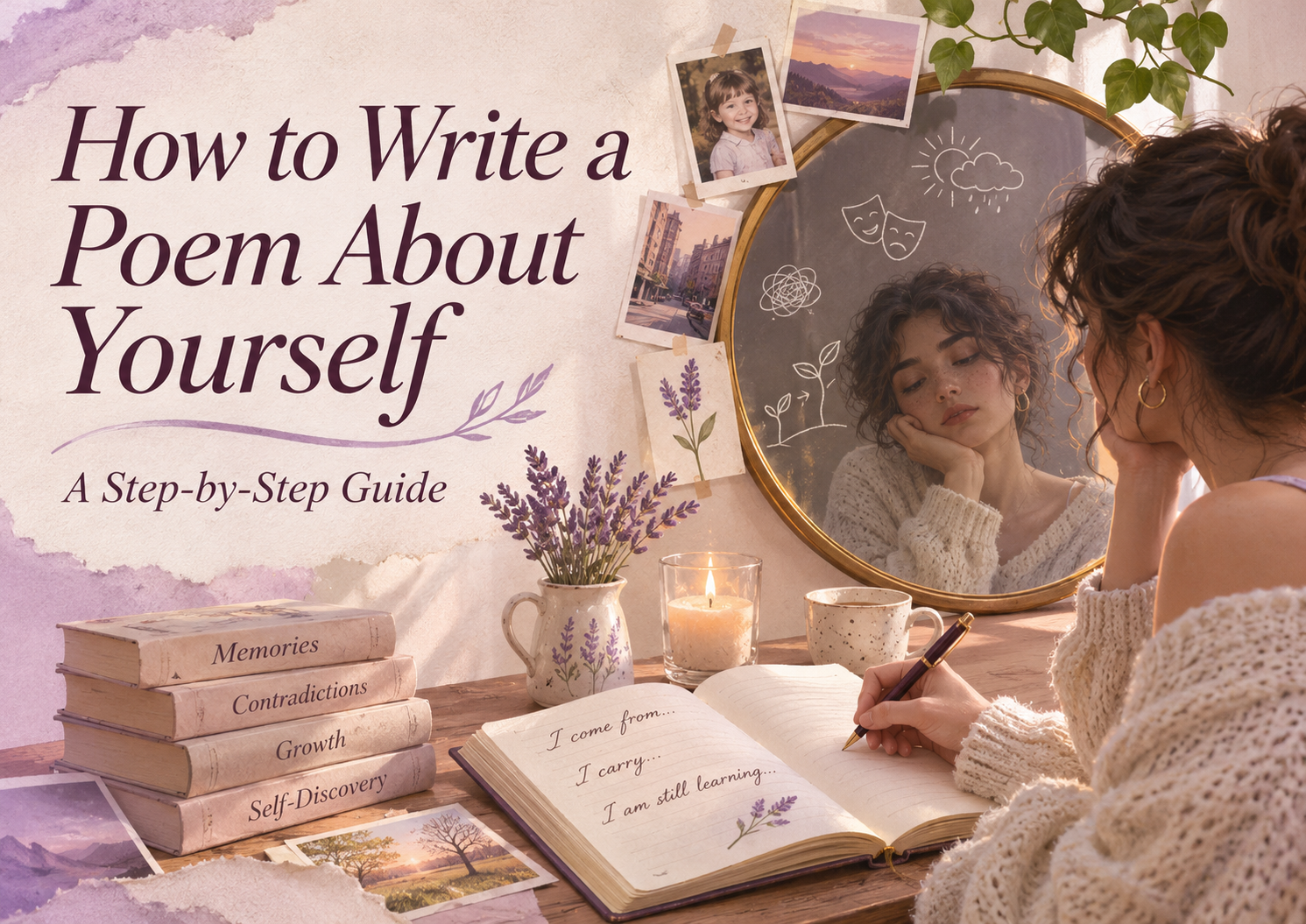
- "I come from…"
- "Nobody notices that I…"
- "I used to believe…"
- "I carry…"
- "I am still learning…"
Avoid stacking labels such as "kind, strong, creative." Show one moment in which a quality becomes visible.
5. Give your poem a small movement
Even a short self-portrait benefits from change. Start in one place and end somewhere slightly different: from a memory to the present, from fear to curiosity, or from a question to an image.
A simple structure is past → present → possibility. You do not have to solve anything in the final line. A good ending can leave a door open.
6. Read a complete example poem
Here is an original free-verse poem about identity and growing up:
The Things I Keep
>
I keep a ticket from a town
I thought I would never leave.
It sleeps between two pages
of a book I rarely open.
>
I speak more loudly now,
but still fold my questions small.
Some mornings I recognize myself
in the window before the train arrives.
>
I am not the place I came from,
and I have not left it behind.
Notice how the poem never says "I am nostalgic" or "I am becoming more confident." The ticket, book, questions, and train window carry those ideas. Its ending accepts two feelings at once.
7. Revise without erasing your personality
Leave your draft for a few minutes, then read it aloud. Look for these improvements:
1. Replace one general phrase with a real object, gesture, or place. 2. Remove a repeated explanation if an image already expresses it. 3. Listen for awkward lines. Break a line where you want a pause, not just where it looks pretty. 4. Keep the unusual detail. It may be the most recognizable part of your voice. 5. Check your ending. Does it reveal something new or simply repeat the beginning?
For example:
| First draft | More personal revision |
|---|---|
| "I have changed a lot over time." | "The coat I once lived in / no longer fits my shoulders." |
| "I miss being a child." | "I still know the shortcut / behind my old school." |
The revision is not automatically better in every context. It is more concrete, so the reader has something to see.
A ten-minute exercise: write a self-portrait in six lines
Write exactly six lines, using this sequence:
1. An object you own. 2. A sound you remember. 3. Something you once believed. 4. A habit you have today. 5. A contradiction about yourself. 6. An image of the person you are becoming.
Do not worry about rhyme. Once the six lines exist, rearrange them and remove any line that explains what the others already show.
If you want to experiment with word choice, rhythm, or a line that does not feel right, Lyrai can help you analyze and refine a draft while you decide which suggestions sound like you. Your experience and your choices remain the center of the poem.
Frequently asked questions
How do I start a poem about myself?
Start with one true detail rather than a definition of your personality. Write "I keep…" or "I remember…" and follow the image for a few lines.
Does a poem about myself have to rhyme?
No. Free verse lets you concentrate on imagery, line breaks, and natural rhythm. Rhyme is an option, not a requirement.
What if I do not want to share personal experiences?
You can write about harmless details, use metaphor, invent a speaker inspired by yourself, or keep the poem private. Being personal does not mean revealing everything.
How long should a poem about myself be?
Long enough to develop one meaningful observation. Six to twelve lines can be plenty for a first draft; there is no fixed length.
Your first line is enough to begin
A poem about yourself does not need to explain who you are forever. It only needs to capture something true about you today. Choose one detail, write a line, and see where it leads.
Your turn to put down a few words.
Try it free